“Solitary Moments”

This blog post is inspired by a Photography Exhibition I went to today.

The Exhibition featured the images of Chris Donaldson, Frank Alvaro, Ray Finneran, Enrico Scotece and Paul Dorahy, three of whom I have known personally for many years. They specialise in Medium Format Monochrome Film Photography, and develop and print their own images.

“Solitary Moments” for them are those moments when they pre-visualise the idea and image, then spend the time photographing the scene, with the camera on a tripod. It is quite likely that they may only take 1 – 4 images in a day… Their “Solitary Moments” continue in the act of developing the negatives and seeing the finished prints appear ‘like magic’ in the developing tray.

Having experienced the above, I can certainly identify with the “Solitary Moments” they are speaking about.

Shooting Medium Format Film from a tripod-mounted camera slows you down. This helps you get a feel for the scene that you want to photograph i.e. the greater connection you have with the subject the greater chance you have of communicating what you want to say. Here the pre-visualisation continues as you imagine what the final image will look like before you take the photo.

It is later, in the Darkroom that you continue the process to achieve what you set out to communicate initially.

It reminds me of the “Solitary Moments” I have and am experiencing in my aim to become a better writer of Poetry and my fledgling steps of becoming an Oil Painter.

The processes whilst different in terms of the technology used, have some parallels.

I remember on my last trip to Joadja, a historical Shale Mining town in New South Wales, Australia. I took my camera gear and a visual art diary, pens and pencils with me.

These days I shoot digital and whilst the urge was there to do what many do with DSLR’s these days, i.e. shoot a 100 shots and then move on, I decided to sit down and ‘get a feel’ for what was in front of me, absorb the sense of history whilst studying the light and possible compositions.

The pencils came out first and I began to make some rough sketches after walking around the subject. I jotted down in a few words about how I felt and what I was seeing (which later became the poem below). The camera came out next and I again walked around the scene, pausing to take it all in before I started to shoot.
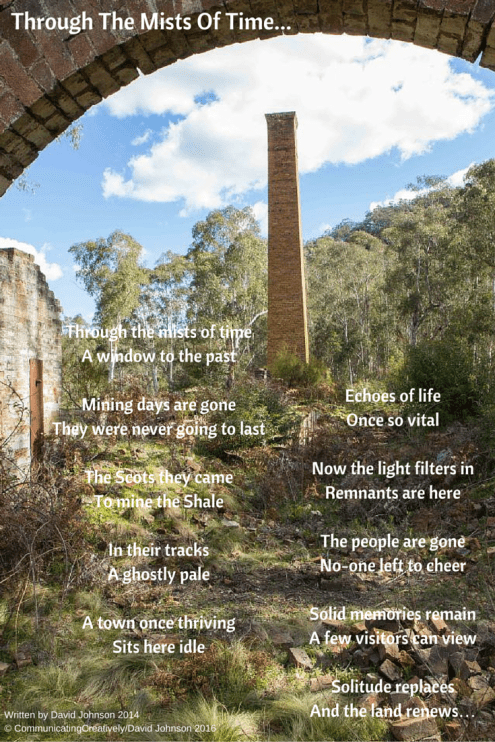
Through The Mists Of Time...

“Solitary Moments” are precious things to experience.

They also come whilst I am fleshing out an idea for a poem, when I sit at my canvas and endeavour to communicate what I feel I want to say, or when I am writing a speech.

I, like the photographers in today’s exhibition are looking forward to many more…

Written by David Johnson
1 May 2016

Exhibition details:

The Bowral Art Gallery – home of the Bowral & District Art Society & BDAS workshops. 1 Short Street, Bowral NSW Australia (02) 4861-4093
April 27 to May 10 Solitary Moments – Chris Donaldson, Ray Finneran, Frank Alvaro, Enrico Scotese and Paul Dorahy.

For more “Solitary Moments” click on the following links:

http://www.chrisdonaldson.com.au
http://www.rayfinneranphotography.com
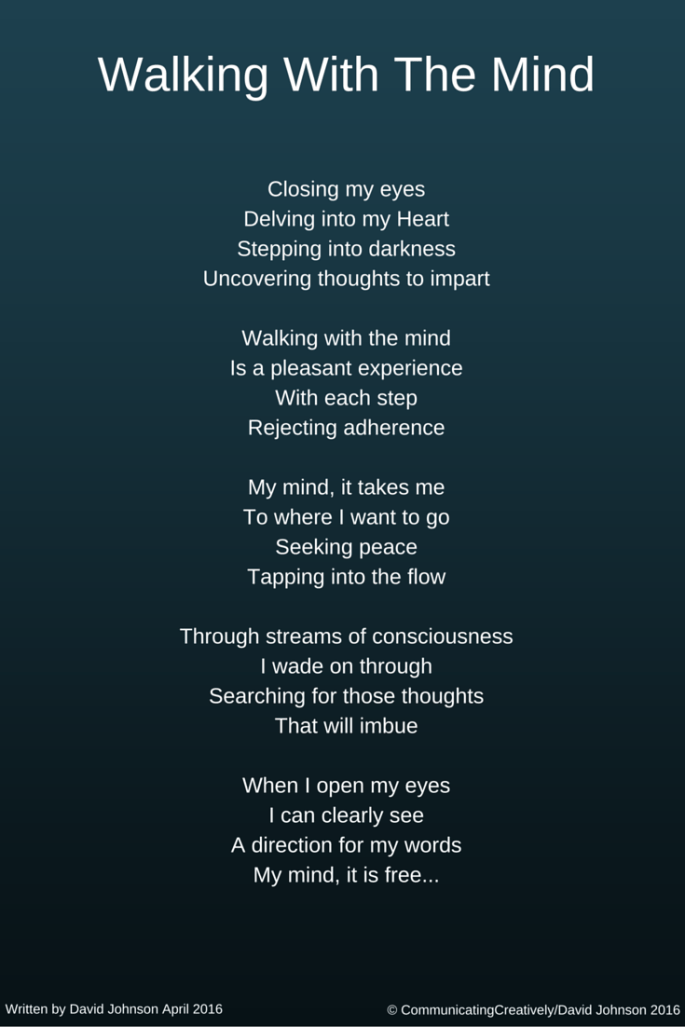
 

Walking With The Mind

Walking With The Mind-3

Where Is The Mystery?

When I first started photographing seriously (early 80’s), one of the attractions of photography was the mystery of how one would be able to achieve the image. In this instance I am talking about the technical process rather than the imaginative one that is connected with the idea or desire to portray a subject/emotion.

It was (and remains) a fascinating process. Light entered the camera and exposed the film which then was developed, then printed. There were a number of variables at each stage that could alter the way the image was captured and developed, let alone the printing process in the Darkroom.

To obtain a technically proficient image one had to perfect the techniques required to obtain the best possible image in your negative or positive image.

Fast forward to the Digital world. For some years now (due to the advances in technology, and indeed the Digital format itself), it has never been easier to obtain a ’technically proficient’ image in terms of the basic reproduction of a scene.

On the one hand, this is a positive, as it allows the photographer to concentrate more on the ‘creative’ side of things, knowing that they have the initial in-camera/process taken care of. On the minus-side it has taken away skills, enjoyment and a sense of challenge that many found to be a key part of the photographic process. Learning to choose the appropriate film, exposure, development time etc to gain a negative or positive that would help produce the desired results in printing was the goal.

There was a certain ‘mystery’ connected with the early part of the process i.e. through the processing of film and the effect of light on silver halides through exposure and development (before the darkroom printing stage) which has been lost to a certain degree. Once learnt, those techniques could be applied, but of course that took time…

I am not for one minute saying Digital is a bad thing as the Digital process has brought with it many benefits, one I have already alluded to. I shoot Digital myself.

Of course we do have the wonderful world of image manipulation programmes where we have the choice to alter images with abandon, depending on what we want to achieve. This is a great thing. With all this at our disposal though, sometimes I wonder if the technical aspects of photography have been made too easy?

Even though my passion for photography is as strong as it always has been I have (in the last few years) been slowly getting interested in painting and am currently learning Oil painting. There is certainly a ‘mystery’ there in terms of getting a ’technically proficient’ image.

I cannot just go out and purchase a brush/canvas/paint combination that will give me a technically proficient image. One has to endeavour to learn the skills, practice, make mistakes, learn some more, and repeat the process. (I am aware that I could do ‘Oil’ Painting digitally but that doesn’t hold an interest for me). Once I get better at these skills I will be able to communicate what I want to say, better and in more creative ways.

I love Art and my love for photography will continue throughout my life however my love for painting has increased with each passing year, to a point where I now aiming to allocate a certain amount of time every weekend to painting.

Much like coming up for an idea for a photograph or looking at a scene through a viewfinder, I can look at my blank canvas and proceed to paint an idea or sit outside and interpret a scene.

Ultimately though, what continues to separate individual photographers and individual painters is our imagination and the ability to convey the desired idea through creativity and technical skill.

Harry Callahan, Photographer – 1912 -1999 once said:

“The mystery isn’t in the technique, it’s in each of us…” – More Joy of Photography, Eastman Kodak – 1981

Where is the mystery?

“The mystery is in the learning and application of the technique which we then use via personal expression to creatively communicate our ideas…”

Written by David Johnson
2 April 2016

Profiling Photographers – Barry Moore

I first met Barry Moore via my membership in Toastmasters International. Barry is also a member and previously was the District 70 Toastmasters Official Photographer, and is an accomplished speaker himself. Thank you Barry for participating in this series.

Gear: Canon 5D Mkii, 50D, 400D, EOS-M – various L and non-L lenses from 10mm to 400mm. Panasonic Lumix DMC-TZ30 is my favourite portable camera for bushwalking.

  • Why did you choose Photography as your medium of communication?  

I have always enjoyed the creative process. Snapshots capture a moment in time but can tell a story as well. Landscape’s convey the beauty and isolation of a remote areas as well as the memory of the adventure. I started with an instamatic slide camera, then a TTL 35mm SLR (Hanimex Aka Practika clone). Then an OM1 for ages before the digital revolution. But it’s not the camera or lens. Often it’s that you see the shot or anticipate the shot and then capture it. There almost a sense of a “hunt” for the best shot and then the smile of satisfaction of “nailing” the composition.

  • Which Photographers have been the greatest influences on you & why? 

Ansel Adams and David Moore are great examples – they tell a story with a single image. My current favorite in Ken Duncan. Sheer beauty and the enormous patience to get his compositions right are amazing.

  • What inspires you to create the type of images that you do?                

I want a “wow” or “Ah” when people see my pictures. I love remote areas and it is great to be able to share the image and location with them.

  • What do you think makes your style unique? 

I like all style…. Deep silhouettes and shadows give great depth to an image, so I look for this.

  • Do you have any advice for an aspiring photographer? 

Practice and experiment. Attention to details is paramount. Check the background always and remove all distractions from the image if you can. Get rid of any ‘bad’ photos and try to only show the best. It’s hard to do this though.

  • What is the next big adventure for you, photographically?

I want to do some model photography or street candids. It’s an area I am lacking in.

To explore more of Barry’s creativity, click on the following inks:

http://www.pbase.com/barry_2718

http://www.modelmayhem.com/barry2718

Eligia Sword – Profiling Photographers


Welcome to another instalment in the series, Profiling Photographers. Eligia is passionate about photography and wildlife and very active in the Camera Club world in Brisbane. I hope you enjoy her insights and photography as much as I do. Thank you Eligia for being part of this series.

Gear:

Canon 5DMk3 Camera. Lenses: 100-400, 24-105, 100 Macro and 50 Prime 1.8. My next purchase will be a wide angle lens.

Why did you choose Photography as your medium of communication?

I won a minor footy tipping contest and decided to buy a camera. Joined a Camera Club, took some beginner’s lessons and haven’t looked back since. It is not a passion, it has become an obsession in a good way.

Which Photographers have been the greatest influences on you & why?

I don’t have any favorite photographers at the moment. I visit lots of Websites, read magazines, go to photo exhibitions and join online photography sites to expand my knowledge of the type of photographs that are possible to create. I have learnt a lot at the Photographic Club with the guest speakers, long time members and entering the monthly competitions.

UntitledES1

What inspires you to create the type of images that you do?

I like to go for a walk in the morning and my camera comes with me. I have developed a great interest in birds, bugs and butterflies. I don’t have any trouble finding any of those in the local parks and if I can’t get out and about I can always find some in my back garden.

What do you think makes your style unique?

 I’m a bit of a perfectionist and I don’t give up on a photo until I’m satisfied that I couldn’t do any better.

UntitledES2

Do you have any advice for an aspiring photographer?

Have your camera with you at all times. Photograph most days if you can and try all sorts of photography. Eventually you will find what you are good at and when that happens I bet you won’t be able to stop.

What is the next big adventure for you, photographically?

I would love to go to Africa. To me it would be the ultimate wildlife adventure.

The next photographer in the series will be ‘Barry Moore.’

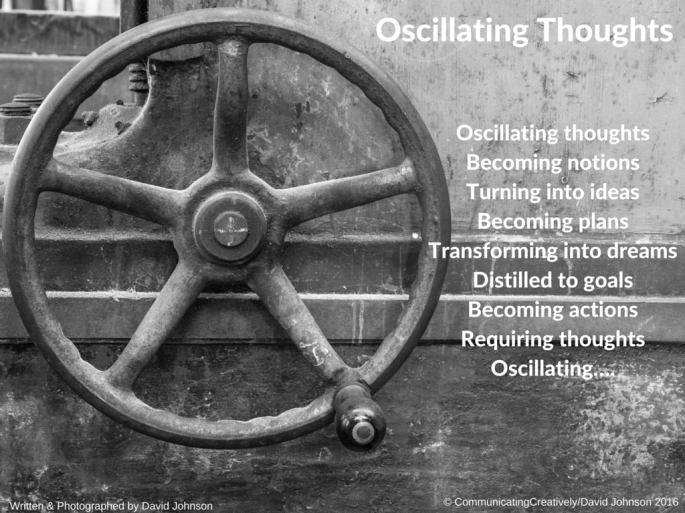
Oscillating Thoughts

Oscillating Thoughts 2